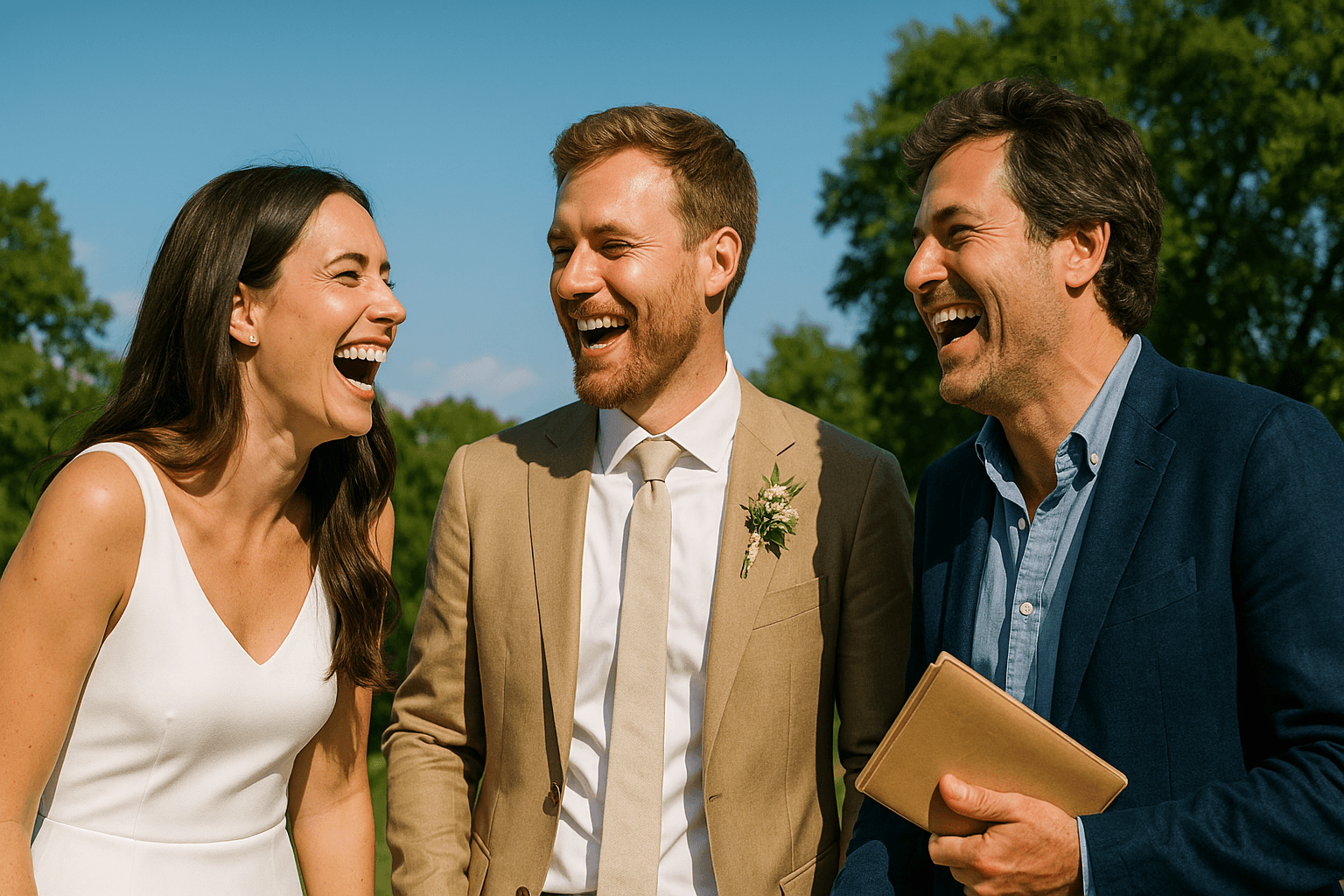
Two friends asked you to marry them. You said yes before fully thinking it through. Now you're staring at a calendar and wondering what officiating a wedding actually involves.
Short answer: less than you think, more than the internet implies. Here's the full path from yes-I'll-do-it to pronouncing-them-married.
1. Get ordained — yes, you, in five minutes
To legally sign a marriage license you need to be a "minister" in the eyes of the state. The bar is low and the path is online.
Get ordained with Church of Pride for $20 — we'll email your certificate, mail your credential, and you're recognized for life. No coursework, no doctrine, no statement of belief required.
If your friends are a queer couple, this matters: not every online church will ordain you with the explicit purpose of marrying LGBTQ couples. Church of Pride was built for it.
2. Check the state's officiant rules
Your ordination is the credential — but the state where the wedding happens decides what counts. Most states accept online ordinations without ceremony. A few require you to register with a county clerk before the wedding. A handful (Virginia and parts of Pennsylvania historically) have been picky about online ministers.
The fastest move: search "[state name] wedding officiant requirements" on our states directory, or call the county clerk's office where the marriage license will be issued and ask, "Do you accept online ordinations from a religious organization, and is there anything I need to file before the wedding?" Write down what they tell you.
3. Get the marriage license logistics right
You don't get the license — the couple does. They go to the county clerk's office (sometimes weeks ahead, sometimes 24 hours, depending on the state's waiting period) and pick up the marriage license. After the ceremony, you sign it as the officiant, the couple signs, witnesses sign, and someone returns it to the clerk within whatever the state requires (usually 5–30 days).
Tell the couple now: don't lose the license. You'd be amazed how often it goes missing in the chaos of the wedding day. Suggest someone designated holds it.
4. Talk to the couple before you write anything
Before you draft a single word of the ceremony, sit down with them — coffee, video call, whatever — and ask:
- How long do you want the ceremony to be? (15 minutes is the sweet spot; 30+ feels long unless there are readings.)
- Religious, secular, somewhere in between? Even if the couple isn't religious, some families expect a mention of God or a moment of silence. Get clarity.
- Are you writing your own vows, or do you want me to lead you through "repeat after me" vows?
- Anyone giving a reading? Speaking? Walking who down the aisle?
- What story do you want me to tell about how you got here? Ask for two or three specific moments — the first date, the first argument, the night they decided.
- Anything off-limits? Estranged parents, recent loss, an ex who's still a friend — find out before you accidentally land on a landmine.
Take notes. The ceremony is theirs, not yours.
5. Write the ceremony
A standard wedding ceremony has these parts:
- Welcome — greet everyone, say why we're here.
- A few words about the couple — your story, the one you collected above.
- The "purpose of marriage" reflection — a paragraph on what marriage actually means. Skip the boilerplate; say something true.
- Readings (optional) — a poem, a passage, a friend speaking.
- Declaration of intent — "Do you take..." This is the part the state cares about. Both parties must say "I do" (or equivalent). It's the legal heartbeat of the ceremony.
- Vows — either the couple's own, or repeat-after-me.
- Ring exchange — short, sweet, a sentence each.
- Pronouncement — "I now pronounce you married." Use whatever language fits the couple — married, spouses for life, partners, husband and husband, wife and wife, whatever they've told you.
- The kiss — keep it light. "You may now kiss."
For queer couples, default to neutral framing unless they've told you otherwise. "These two people" instead of "this man and this woman." "Their love" instead of "her love for him." If they want to be called husband and husband or wife and wife, lean into it joyfully. If they want spouses or partners, that's also right.
We wrote a separate post on writing an LGBTQ-affirming wedding ceremony — read it before you start drafting. And if you'd rather adapt a complete script than write from scratch, our non-religious wedding ceremony script comes in three lengths, with same-sex wedding vow examples to match.
6. Rehearse — out loud — at least three times
The single biggest mistake first-time officiants make is reading the ceremony silently and assuming they'll be fine on the day. They are not fine on the day. Voices wobble, words come out wrong, you forget that some lines are supposed to make people laugh.
Read the whole thing out loud. Twice in your kitchen. Once at the rehearsal in the actual space. Listen for awkward phrasing and cut it. Aim for sentences you can say without breath panic.
7. The day of
- Print two copies of the ceremony. One for you, one for backup-you (in your bag, in case you spill coffee on the first).
- Bring a pen — the kind that won't smear on the marriage license.
- Arrive 45 minutes early. Find the wedding coordinator (if there is one), confirm where you stand, confirm the music cue.
- Drink water but not too much. You can't pee during the ceremony.
- Look at the couple, not the audience. They are who you are talking to. Everyone else is overhearing.
- Slow down. First-time officiants always speed up out of nerves. Take breaths between sentences.
8. After the ceremony
Sign the marriage license. Make sure the couple and witnesses sign. Confirm someone is responsible for mailing it back to the clerk. If you're the responsible adult: do it yourself, that week.
Then go celebrate. You just married your friends.
A note from us
Officiating a friend's wedding is one of the most meaningful things you'll ever do for someone. Don't overthink it. The couple already loves each other — your job is to hold space for that, say a few true things, and sign the paperwork.
If you're ready to start, get ordained with Church of Pride — instant certificate, credential in the mail, recognized for life.