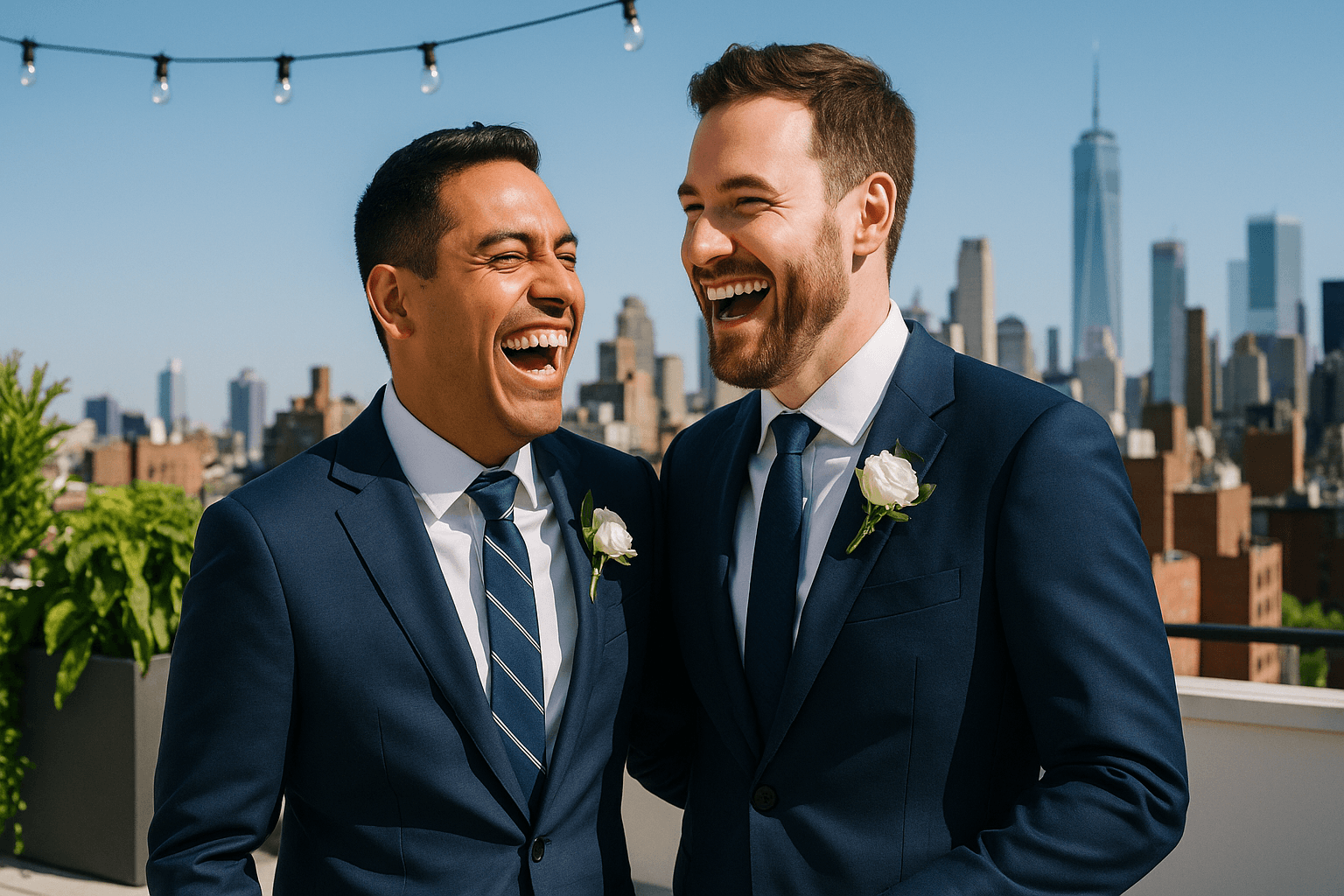
Most "gay wedding ceremony scripts" on the internet are the hetero default with "groom" pasted in twice. A couple of them try too hard — every line about how this is historic and important and finally legal, until the ceremony forgets to be about two specific people getting married. The room can tell.
This script is for two men who are marrying each other. It assumes the room is glad to be there. It treats the wedding as the wedding, not as a referendum on the wedding. Use it as written, or take whatever's useful and rewrite the rest.
How long, how loud, how literary
About 15 minutes. Speak slowly — first-time officiants always speed up out of nerves. Mix some humor in if the couple is funny; keep it dry if they're not. The script is a frame. The couple is the picture.
The full two-grooms ceremony script
Welcome. Good [afternoon / evening]. I'm [Name], and today I have the singular honor of marrying [Groom 1] and [Groom 2]. Some of you have flown a long way. Some of you walked over from the next room. Either way — you're here, and that matters, because [Groom 1] and [Groom 2] specifically wanted this room to witness this thing.
On marriage. Marriage is a strange and excellent institution. Two people stand up in front of everyone they love, say a few sentences out loud, and walk back down the aisle legally bound to each other. That's it. That's the trick. There's no spell. There's no transformation. There's just two people, in a room, choosing each other in a way they can't take back without a lawyer.
[Groom 1] and [Groom 2] are choosing each other today. They've actually been choosing each other for [X] years — at every coffee, at every airport pickup, at every fight they decided not to have. This part — the standing-up-in-front-of-everyone part — is just the loud version of what they've been doing quietly all along.
About the couple. [Two or three specific details. The night they met. The first apartment. The bad couch. The reason one of them moved across the country. Be specific. Don't summarize the relationship. Pick three frames and let the room fill in the rest.]
(Optional reading.) [A friend or family member reads. See suggestions below.]
Declaration of intent. [Groom 1], do you take [Groom 2] to be your husband — to love him, to stand with him, to keep choosing him through whatever comes — for as long as you both shall live? (I do.)
[Groom 2], do you take [Groom 1] to be your husband — to love him, to stand with him, to keep choosing him through whatever comes — for as long as you both shall live? (I do.)
Vows. [Each groom reads. Or repeat-after-me, using the template below.]
I, [Groom 1], take you, [Groom 2], to be my husband. I promise to choose you on the easy days and the hard ones. To be your steady ground when the world is loud. To be your soft landing when everything else is sharp. To love you, plainly and unmistakably, for as long as we both shall live.
Ring exchange. Two rings, one each. Every time one of you sees this ring on your hand, let it remind you what you said today — not the romantic version, the real version. I chose this. I keep choosing this.
[Groom 1], place this ring on [Groom 2]'s finger and repeat after me: With this ring, I marry you. May it remind you, every day, that I chose you.
[Repeat for the other partner.]
Pronouncement. [Groom 1] and [Groom 2] — you have made your promises out loud, in front of everyone in this room. By the power vested in me by the state of [state], I now pronounce you husbands.
You may kiss.
Vow lines that work for two grooms
Pick four to six for each groom. Make them different. Asymmetry is the point — these are two different men, not a matched pair.
I vow to be the husband you can come home to. Every day. Without performance.
I vow to choose you on the easy days and on the days I'd rather be alone.
I vow to love you in plain English. No guessing. No reading between lines.
I vow to keep showing up — to your mother's birthday, to your worst Mondays, to the version of you who's tired and undone.
I vow to fight fair. To never use a thing you told me in private as a weapon when we argue.
I vow that you will always know where you stand with me.
I vow to be the husband who notices the new haircut. Who packs your lunch when you're stressed. Who remembers the names of your friends' kids.
I vow to grow old with you, gracefully or otherwise. We probably won't do it gracefully.
I vow that the words "I love you" will not become routine in our house. They will mean something every time.
If they want a funny line or two:
I vow to share the bed but not the blankets.
I vow to pretend to like your family. Some of them I won't have to pretend with.
I vow to never throw away your weird coffee mug.
Want more options? Our same-sex wedding vows collection has 40+ examples, including a full two-grooms section.
Reading suggestions
Skip the wedding-ceremony-readings-Pinterest results — they're 80% generic. Five readings that actually land at a two-groom wedding (and twenty more in our LGBTQ wedding readings list):
- An excerpt from Giovanni's Room by James Baldwin. Anything from the early chapters about love and recognition. Carries weight without being a downer.
- "Litany in Which Certain Things Are Crossed Out" by Richard Siken — modern, intense, unmistakably about loving a man. Not for every wedding. For the right wedding, devastating.
- Wendell Berry, "The Country of Marriage." Universal but the language about long companionship reads beautifully at any wedding where the couple has been together for years.
- Ocean Vuong, an excerpt from On Earth We're Briefly Gorgeous. Pick a paragraph; the prose is the kind that makes a room go quiet.
- The "Letter to a Young Poet" passage by Rilke — the one about solitude in love. It's old, it's slightly clichéd at this point, but at a gay wedding it lands fresh.
What to cut
- "Speak now or forever hold your peace." Not legally required anywhere. Drop it.
- Walking down the aisle with parents who are uncomfortable being there. If a parent is reluctantly walking a groom down the aisle, just have the grooms walk in together instead. Cleaner. More honest.
- Anything that frames the marriage as a "victory" or a "milestone for the community." If the couple wants to acknowledge the history, they will, in their own vows. The officiant doesn't need to politicize it on their behalf. The ceremony is for them.
- The default "man and wife" boilerplate. Some templates still slip this in. Read aloud before the day.
On the politics question
A lot of officiants ask: should I acknowledge how recent marriage equality is? Some couples want that — it matters to them that the wedding sits in a long arc. Some couples don't — they want the wedding to be a wedding, not a history lesson.
Ask. Don't decide for them.
If they want it acknowledged, one line is enough. "This wedding is happening because two men chose each other and because, in 2015, the law caught up to that." That's the whole acknowledgment. You don't need a paragraph.
If they don't want it acknowledged, don't sneak it in.
Getting ordained
If you're a friend who's been asked to officiate, get ordained with Church of Pride for $20 — recognized for life, no doctrine. We were built for officiants marrying queer couples and we'll send you a letter of good standing if any county clerk pushes back. Read the friend-officiant guide and the LGBTQ-affirming ceremony guide before you start drafting.
And rehearse. Out loud. Three times minimum. The wedding doesn't wait for you to find your place in the script.