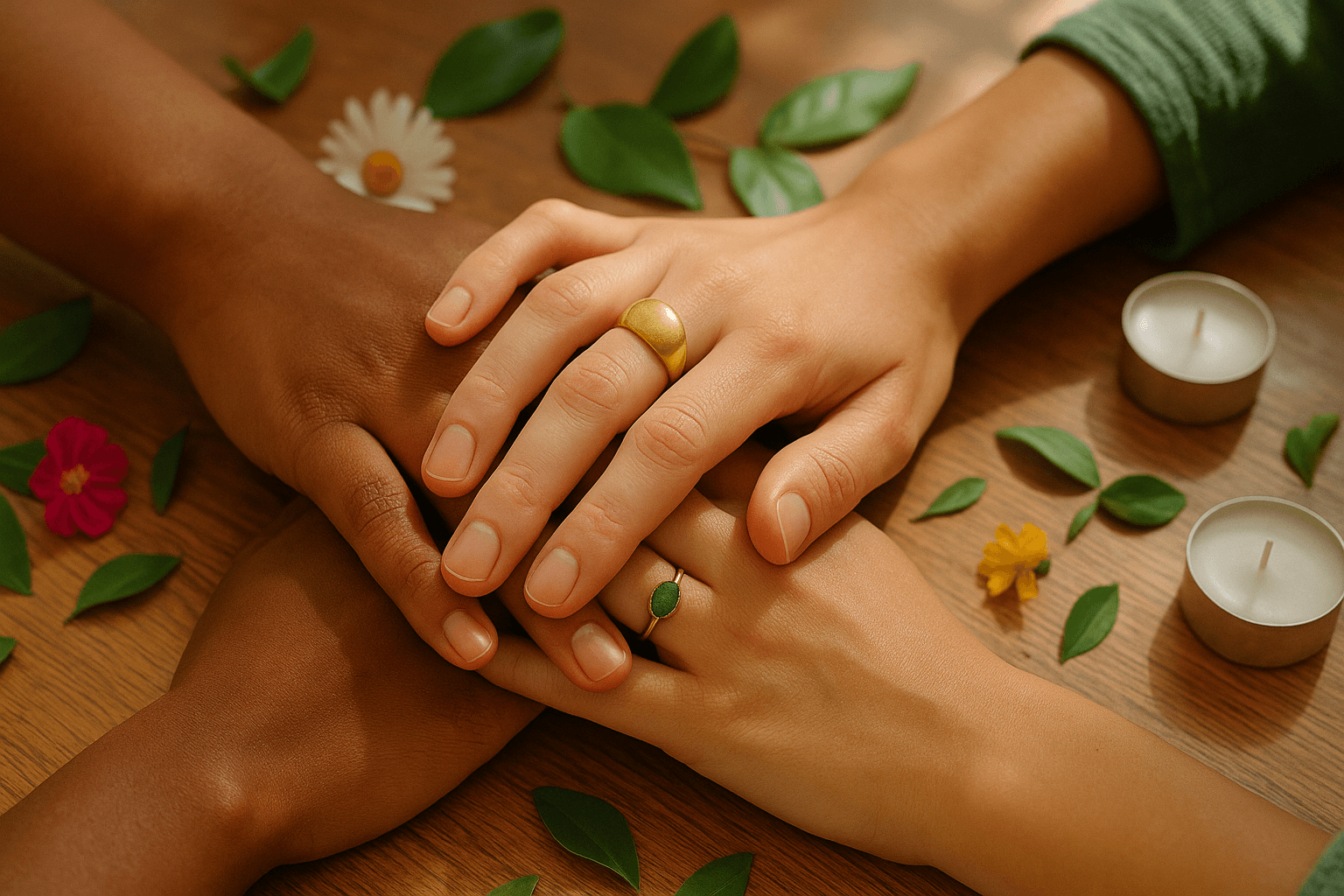
Three people walk into an officiant's inbox. Two of them are getting legally married — the third partner is not legally part of the marriage, but they are emotionally, practically, and in every other meaningful way part of the relationship. The triad asks: can you do a ceremony that recognizes all three of us, even though only two of us are signing the license?
Yes. With care. Here's how it works.
What's possible legally — and what isn't
Marriage in every US state is a contract between exactly two adults. A polyamorous triad or quad cannot, today, legally marry more than two members. The single exception, sort of, was the city of Somerville, MA — which in 2020 recognized polyamorous domestic partnerships locally — but this is a domestic partnership, not a marriage, and it does not extend to the rest of the country.
What this means practically:
- Two of the partners can have a legal marriage, with a marriage license and all the legal benefits that come with it.
- All of the partners can have a commitment ceremony — a non-legal but emotionally and socially recognized ritual that everyone in the relationship participates in.
- Many polyamorous families combine the two: a private legal marriage between the two with the most pressing legal need (often the partners who want to share health insurance or co-parent on paper), and a public commitment ceremony that includes all the partners.
This guide is about that combined ceremony.
The decisions to make first
A few things to settle with the partners, all together, before you start drafting:
- Who is in the ceremony? Two of you, three of you, four? Are there partners who are part of the relationship but don't want to participate in a ceremony? Both of those answers are fine; clarify them.
- Is the legal marriage happening at the same ceremony, or separately? Some triads do the legal license signing as a small, private moment with just the two legally marrying — then have the public ceremony with all three. Others sign the license at the public ceremony but make it visually clear that the commitment goes further than the paperwork.
- What are we calling this? A wedding. A commitment ceremony. A handfasting. A "we threw a party and made promises." Pick the word your family uses and use it on the invitations.
- Do we want the ceremony to acknowledge the polyamory explicitly, or just look like a slightly-larger-than-usual ceremony? Some triads want the room to understand exactly what's happening. Some want the ceremony to read as a quiet expansion of tradition.
- Who is in the room? Sometimes polyamorous ceremonies are private among the family and chosen family who already know. Sometimes they're public, including parents who are learning. The ceremony script flexes to fit.
A sample script for a triad commitment ceremony
This script assumes three partners. Adapt the count and the pronouns to fit your family.
Welcome. Good [afternoon / evening]. I'm [Name], and today we are here to recognize the commitment between [Partner 1], [Partner 2], and [Partner 3]. They have asked you here because each of you, in some way, is part of the life they have built. Today, they are making the structure of that life explicit — in front of all of you, and in front of each other.
On commitment. A commitment is a promise to keep showing up. Not because you have to. Not because a paper says so. Because you have decided, in the most ordinary sense, that you want to. Marriage is one form of that promise. The promise [Partner 1], [Partner 2], and [Partner 3] are making today is the same kind of promise — three-shaped instead of two-shaped, but no less specific.
[If the legal marriage is happening in the same ceremony:] Today, [Partner 1] and [Partner 2] are being legally married — that's the part the state of [state] recognizes. And all three of [Partner 1], [Partner 2], and [Partner 3] are entering into a commitment with each other — that's the part this room recognizes. Both are real. Both are binding. Both are happening today.
About the family. [Tell the story of how these partners came together. Be specific. The first conversation about expanding the relationship. The night the third partner moved in. The vacation that became the moment everyone understood this was the shape of the family. Two or three specific moments beat any generalization.]
Declaration of intent (three-person form). [Partner 1], do you take [Partner 2] and [Partner 3] to be your committed partners — to love them, to support them, to stand with each of them through whatever comes? (I do.)
[Partner 2], do you take [Partner 1] and [Partner 3] to be your committed partners — to love them, to support them, to stand with each of them through whatever comes? (I do.)
[Partner 3], do you take [Partner 1] and [Partner 2] to be your committed partners — to love them, to support them, to stand with each of them through whatever comes? (I do.)
Vows. Each partner speaks their vows to the other two. (See the section below for line options. The vows can be the same words said three times with different names, or each partner can write their own to each other partner. Either works.)
Ring exchange or other token. Three rings (or three of whatever token the family has chosen). Each partner places a ring on each other partner. This takes a minute longer than a two-person exchange — that's fine; it's part of the visual of what's happening.
[Partner 1], place these rings on [Partner 2] and [Partner 3]'s fingers and say: With this ring, I commit to you. May it remind you, every day, that I chose you and that I keep choosing you.
[Repeat for the other two partners, each placing rings on the other two.]
Pronouncement. [Partner 1], [Partner 2], and [Partner 3] — you have made your commitments to each other, in front of everyone in this room. [If the legal marriage is occurring: By the power vested in me by the state of [state], I now pronounce [Partner 1] and [Partner 2] legally married.] By the authority of the room you are standing in, and the witness of every person in it, I declare you a committed family. The three of you — together.
Vow language for polyamorous partners
I vow to love you alongside the people you love, and to make room in our life for all of those loves.
I vow that I will not be a love that asks you to shrink. I will be a love that asks you to keep becoming.
I vow to do the work of communication. Out loud. In words. Even when it is hard. Especially when it is hard.
I vow that what is between us will always be ours, even as our life includes others.
I vow to be specific in my love. I am promising to love you — not love in general. The particular you. The one I am standing across from now.
I vow to celebrate the loves the rest of our family has. To be in a household where every love is allowed to be its own thing.
I vow to be patient with the awkward conversations. To go first when going first is needed. To wait when waiting is the right move.
I vow that you, and you, and you, are mine. And I am yours. All three. Equally specific. Equally chosen.
Things to make easier on the day
A few practical notes:
- The marriage license signing, if happening, should be visible. Many triads describe the license signing as the moment where one specific legal recognition happens, alongside the broader recognition the ceremony performs. Don't hide the license. Put it on a small table. Sign it in front of the room. Acknowledge what it is and isn't.
- Programs help. If you're inviting guests who may not understand the structure of the family, a one-paragraph note in the program ("Today, A and B are being legally married, and all three of A, B, and C are committing to each other as a family") prevents fifty whispered conversations during the ceremony.
- Have a designated person to handle questions from guests after the ceremony. Some guests will be confused. Some will want to ask intrusive questions. Don't make the partners do this work themselves on their wedding day.
- Photos that include all three partners, equally framed, in every group. Brief the photographer in advance: this is not two-with-a-plus-one. All three are partners.
On naming and titles
Different polyamorous families use different language. Pick what fits:
- Spouses. Works across any configuration. Two spouses, three spouses — language scales.
- Partners. Works the same. Sometimes preferred when one partner is legally married to another and a third is "the third partner" — all three are partners.
- Husbands / wives. Use when the family wants it. Three husbands is a beautiful pronouncement when it fits.
- Metamours. A term polyamorous families use for "my partner's other partner." Not usually used in ceremony language, but worth knowing.
Use what the family uses. If they don't have settled language yet, don't impose it.
A note on legal protection
Polyamorous families often need additional legal documents to protect the non-married partners — wills, healthcare proxies, parenting agreements, cohabitation agreements. This is real legal work that should be done with a family-law attorney experienced with non-traditional families. The ceremony is one piece. The paperwork is another. Don't conflate them.
Resources worth knowing:
- Chosen Family Law Center — a nonprofit firm specializing in legal planning for polyamorous and LGBTQ+ families.
- National LGBT Bar Association — directory of attorneys with experience in non-traditional family structures.
Your officiant is not your lawyer. Make sure both roles are filled.
Getting ordained
If you've been asked to officiate a polyamorous commitment ceremony, get ordained with Church of Pride for $20. The legal marriage portion (if there is one) requires an ordained officiant per the usual rules. The commitment portion does not legally require an officiant, but most families want one, because the symbolic weight of someone presiding matters.
Read the LGBTQ-affirming ceremony guide and the pronouns at a wedding guide before you finalize the script. Then rehearse — out loud, three times minimum, with extra attention to the three-person passages. The pacing is different from a two-person ceremony. You'll feel it once you say it.
The family is choosing to do this in public. Your job is to make the public part feel as obvious as the private part already does.